
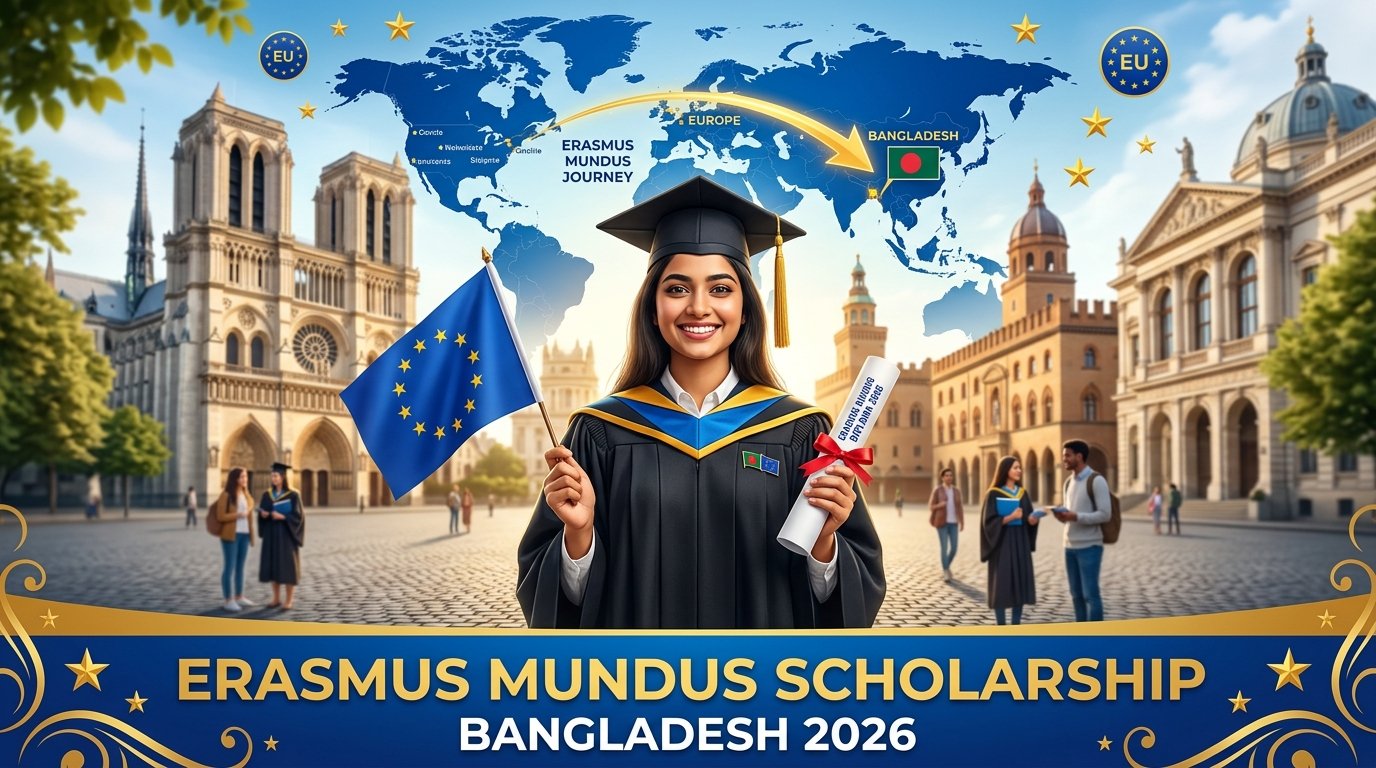
Erasmus Mundus Joint Master Degrees (EMJMD): European Academic Excellence
The Erasmus Mundus Joint Master Degrees (EMJMD) represent the pinnacle of international higher education cooperation financed by the European Commission. Selected candidates complete high-level integrated study programs delivered by an international consortium of higher education institutions across at least two European countries.
For Bangladeshi candidates, this program provides not only immense prestige on academic CVs but also complete financial independence throughout 12 to 24 months of rigorous study in France, Germany, Italy, Belgium, Spain, or the Netherlands.
Financial Award Breakdown for Bangladeshi Scholars (Partner Country Category)
| Scholarship Component | Official EU Allocation (EUR) | Value in Bangladeshi Taka (€1 = ৳131) | Disbursement Frequency |
|---|---|---|---|
| Tuition Fee Participation | 100% Fully Waived (Up to €18,000/yr) | ৳ ২৩,৫০,০০০ / বছর সাশ্রয় | Paid directly to host universities |
| Monthly Living Allowance | €1,000 – €1,400 / month | ৳ ১,৩১,০০০ – ৳ ১,৮৩,০০০ / মাস | Monthly wire transfer to European bank account |
| Travel & Visa Allowance | €3,000 – €4,000 / year | ৳ ৩,৯৩,০০০ – ৳ ৫,২৪,০০০ / বছর | Annual payment for Dhaka-Europe flights |
| Installation Grant | €1,000 (One-time lump sum) | ৳ ১,৩১,০০০ | Paid upon arrival in first host country |
| Comprehensive Health Insurance | 100% Covered (Schengen-wide policy) | ৳ ১,৫০,০০০ / বছর সাশ্রয় | Active throughout entire study duration |
Top 5 Erasmus Mundus Consortia Highly Welcoming Bangladeshi Applicants
1. IMRD — International Master of Science in Rural Development
Partner Unis: Ghent University (Belgium), Humboldt University Berlin (Germany), Wageningen University (Netherlands), University of Cordoba (Spain).
Ideal For: Agriculture, economics, development studies, and geography graduates from BAU, DU, RU, and SUST.
2. ALGANT — Algebra, Geometry and Number Theory
Partner Unis: Université Paris-Saclay (France), Leiden University (Netherlands), Università di Milano (Italy), University of Regensburg (Germany).
Ideal For: Pure mathematics, physics, and computer science graduates from BUET, DU, and SUST.
3. Europubhealth+ — European Public Health Master
Partner Unis: University of Sheffield (UK), EHESP Rennes (France), University of Granada (Spain), Maastricht University (Netherlands).
Ideal For: MBBS doctors, dental surgeons, pharmacists, and public health practitioners from Bangladesh.
4. BDMA — Big Data Management and Analytics
Partner Unis: Université Libre de Bruxelles (Belgium), UPC Barcelona (Spain), TU Berlin (Germany), CentraleSupélec (France).
Ideal For: CSE, SWE, EEE, and Data Science graduates seeking cutting-edge AI competencies.
5. MESC+ — Materials for Energy Storage and Conversion
Partner Unis: Université de Picardie Jules Verne (France), Warsaw University of Technology (Poland), University of the Basque Country (Spain).
Ideal For: Chemistry, materials engineering, and chemical engineering graduates.
How to Write a Winning Motivation Letter for Erasmus Mundus
The Motivation Letter (or Statement of Purpose) carries over 40% of your candidate evaluation weight. Generic statements lead to immediate elimination. Use this verified 5-paragraph structure:
Paragraph 1 & 2: The Specific Academic Hook
Explain why this specific consortium is essential for your thesis. Name exact professors, research laboratories, and unique curriculum modules across host campuses.
Paragraph 3: Undergraduate Thesis & Skills
Detail your final-year undergraduate project, published papers, or relevant industry internships. Highlight specific programming languages, statistical packages, or lab methodologies.
Paragraph 4: Mobility Perspective & Cross-Cultural Fit
Demonstrate how you will adapt to living across 2 to 3 different European countries within 24 months. Emphasize cultural resilience and team collaboration skills.
Paragraph 5: Strategic Long-Term Contribution
Articulate how the specialized European master's degree will enable you to solve systemic engineering, healthcare, or economic challenges upon returning to Bangladesh or working internationally.
Key Deadlines for 2026/2027 Ingestion Cycle
- October 2025: Official EACEA EMJMD catalog opens for international submissions.
- November – December 2025: Early-action deadlines for agricultural and environmental consortia (IMRD, MESC+).
- January 15 – 31, 2026: Peak deadline window for 80% of European engineering, computer science, and public health consortia.
- March – April 2026: Shortlisting interviews via Zoom and announcement of reserve/main scholarship lists.
- May – July 2026: Visa filing at respective European embassies in Dhaka (France, Germany, Italy, Spain).
- September 2026: Departure to Europe and initiation of first-semester lectures!
Schengen Multi-Country Mobility Directive (EU 2016/801) & Visa Navigation
One of the biggest concerns for Bangladeshi applicants is how visas work when studying across multiple European countries. Under the historic European Union Student Mobility Directive (EU Directive 2016/801), Erasmus Mundus scholars enjoy unprecedented mobility rights throughout the 29 Schengen member states:
1. Initial Long-Stay Type D Student Visa
You only apply for a national student visa (Type D) from the embassy representing your Year 1 Semester 1 host university in Dhaka (for instance, the Embassy of France, German Embassy Dhaka, Embassy of Italy, or Embassy of Spain). Your Erasmus Mundus award letter acts as the supreme financial guarantee, removing any requirement for a personal bank statement or blocked account.
2. Intra-EU Mobility Without Returning to Dhaka
When transitioning from your first host nation to your second or third consortium university (e.g., from Belgium to Germany or France to Italy), you do NOT need to return to Bangladesh to apply for new visas. Your consortium university coordinator submits an internal EU Mobility Notification to the next country's immigration bureau, enabling you to study and reside legally across borders.
3. European Banking & Monthly Stipend Management
Upon arriving at your first European campus, the consortium assists you in opening a SEPA-compliant European bank account (such as BNP Paribas, Sparkasse, ING, or digital banks like N26 and Revolut). The monthly stipend (€1,000 to €1,400) is deposited electronically every month, providing complete financial autonomy.
Academic Reference Letters & Europass CV Optimization
Every Erasmus Mundus consortium requires two confidential Letters of Recommendation (LoR). For Bangladeshi applicants, having professors who can specifically attest to your research competencies, laboratory rigor, and analytical writing is essential:
Winning Recommendations Must Highlight:
- Class Ranking: Explicitly state where you ranked among your graduating cohort (e.g., "Top 5% of 120 engineering graduates").
- Research & Methodological Mastery: Mention your thesis title, software tools (Python, R, MATLAB, GIS), and laboratory techniques used.
- Cross-Cultural Readiness: Describe your communication skills, adaptability, and ability to thrive in multicultural academic teams.
- Official Letterhead & Institutional Email: Referees must use official university letterheads and submit directly from institutional domains (@du.ac.bd, @buet.ac.bd, @sust.edu, etc.). Consortia routinely reject Gmail/Yahoo submissions.
Post-Graduation Employment & Marie Curie PhD Fellowships in Europe
Graduating from an Erasmus Mundus Joint Master Degree establishes an elite academic pedigree across the European Union. Most member states provide dedicated post-study work authorization permits to retain top international master's talent:
National Post-Study Work Visas
Depending on where you submit and defend your final master's thesis, you can apply for national jobseeker permits: Germany offers an 18-month jobseeker visa, France offers a 12-month APS residence permit, the Netherlands provides a 12-month Zoekjaar (Orientation Year) visa, and Belgium provides a 12-month search year.
Transition to MSCA Doctoral Fellowships
Over 40% of Erasmus Mundus graduates from Bangladesh transition directly into fully-funded PhD programs or Marie Skłodowska-Curie Actions (MSCA) Doctoral Networks. MSCA researchers are treated as salaried employees in Europe, earning gross salaries between €3,000 to €4,200 per month with comprehensive social security benefits.